


The biggest lie in branding is that one person can do it all. You have heard it every time someone promises a complete brand in three days, at freelancer prices. The truth is simple and uncomfortable: a designer is not automatically a brand strategist. A strategist is not automatically a designer. Strong brands are not built from the confusion between these two skill sets. They are built at the border between them.
If you are an entrepreneur or a freelancer looking for someone to build your brand, you need to understand this difference before you spend a dollar. Otherwise you pay twice: once for a half finished product, and again for the person who fixes it.
This article breaks down what a brand strategist actually does, what a designer actually does, where the confusion between the two costs you money, and how to tell which one you need, or whether you need both.

An effective branding project starts with a clear strategic direction and continues with the development of a coherent visual identity. Brand strategy provides the foundation for logo design, visual systems and brand communication.
What a brand strategist actually does?
A brand strategist does not draw anything. They study the market, analyze competitors, define positioning, and build brand architecture. They ask uncomfortable questions: who are you as a business, who are you selling to, and why should anyone choose you over the competitor next door.
Strategy comes before any visual decision, because without it, design has nothing to express. A beautiful logo without clear positioning is an image that says nothing about who you are or why you matter.
A good strategist asks questions you did not want to hear and forces decisions you have been postponing. It is not a comfortable exercise. It is a necessary one.
What a brand designer actually does?
A brand designer translates strategy into visual identity: logo, color palette, typography, graphic system. Their job is not to invent who you are. It is to make a strategic decision already made visible and memorable.
The designer’s role has evolved, and an AIGA webinar on design’s evolving role points to a shrinking gap between craft and strategic thinking. That does not mean every good designer automatically becomes a strategist. It means a good designer needs to understand strategy well enough not to break it.
Many entrepreneurs mistake a good logo for a strong brand. The gap between a logo and a visual identity is not only technical, it is strategic: a logo is a symbol, visual identity is the entire system that supports it over time, across every channel.
Design without strategy is decoration. Strategy without design stays a forgotten document in a drawer.

Rebranding starts with the brand problem, not with a new logo.
Why confusing the two roles costs you money?
Mixing up strategy and design is more than an academic argument. It has a real price. An Advertising Week analysis of strategy’s role in branding makes the point clearly: design without strategy risks becoming attractive decoration, disconnected from the business’s actual goals.
On the other side, a strategy without coherent visual execution never reaches the customer. It stays theory. A brand consistency report found that brands maintaining a consistent identity across every channel can see revenue grow by 10 to 33 percent. That is the difference between a brand people recognize instantly and one they forget in five seconds.
Confusing a logo with a brand costs money directly. So does assuming that looking good automatically means good branding. Without strategy behind it, you look good for a while, then you get lost in the noise.
What happens when you hire the “does it all” person?
A tight budget pushes you toward fast solutions. You hire a freelancer who promises to handle everything: strategy, logo, website, social media. It sounds efficient. It is actually risky.
A startup advisor’s hiring guidance from Seedcamp points to a common trap: founders think they are saving money by hiring a generalist, but the invisible organizational cost, the time lost to corrections, and decisions made without any strategic foundation end up outweighing the initial savings.
It is not the freelancer’s fault that they cannot do everything. Nobody can. The problem is that you, as the business owner, asked one person to cover two different jobs, built on two different ways of thinking.
Specialization is not a luxury you afford only with a big budget. It is protection for your investment. The more your brand matters to your business, the more it matters who builds it and how.
What the right collaboration between strategist and designer looks like
At BroHouse, strategy always comes before aesthetics. Not because design matters less, but because without a clear direction, every visual decision is a first guess.
Irina Tudose, CMO at Green Pack, worked with several agencies before BroHouse. She noted a transparent, strategic process, different from what she had seen before, one that helped internal teams reconnect with the brand’s values and purpose, beyond a new look.
That is what correct collaboration between strategist and designer looks like: the strategist sets the direction, the designer makes it visible and coherent, and the result carries a real reason to exist. Full branding and strategy services show exactly where a built brand differs from a merely drawn one.
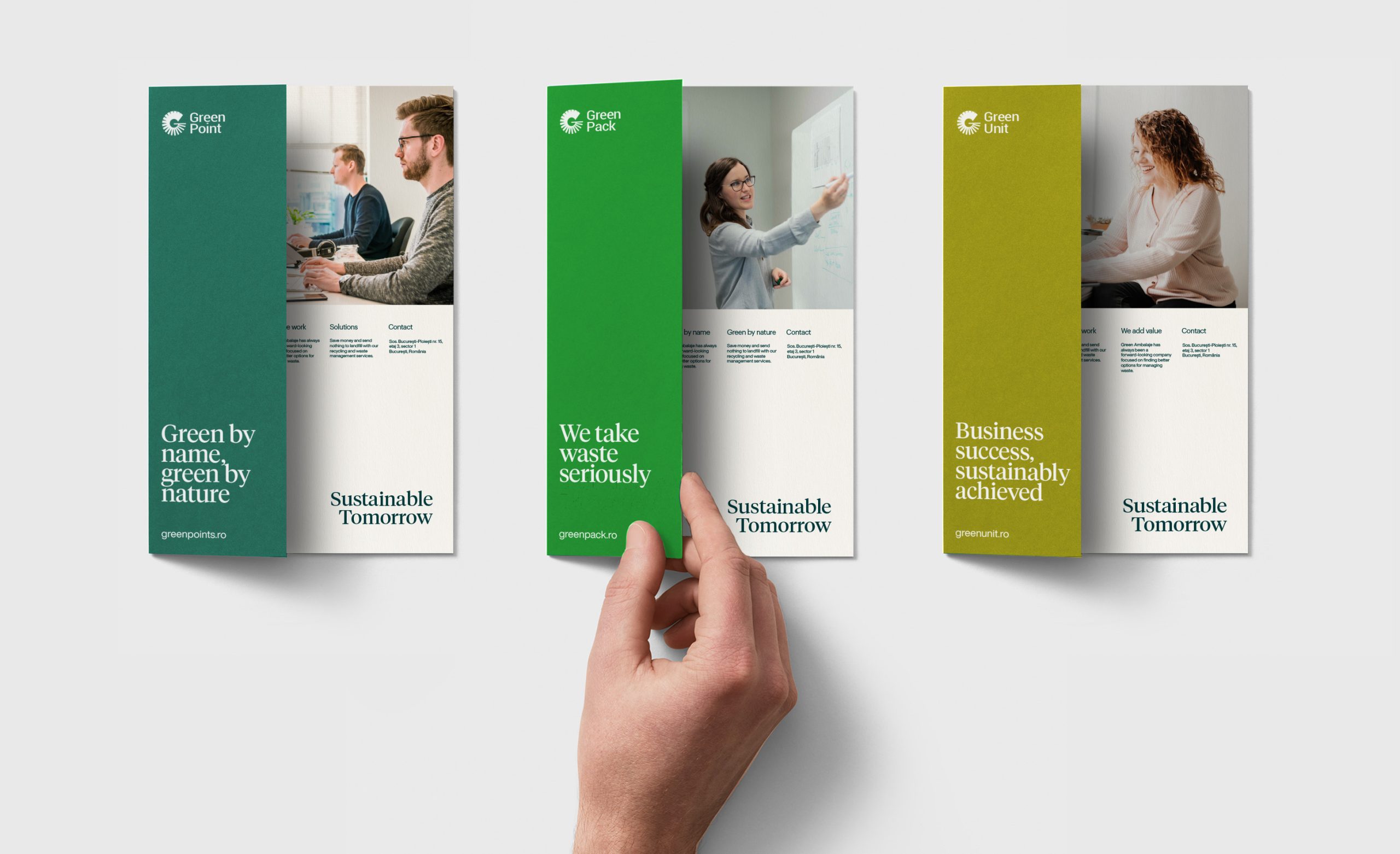
Green Corporation’s identity goes beyond a logo, evolving into a cohesive system of visual elements that work together. Typography, shapes, colors, and graphic elements all contribute to a consistent and distinctive brand expression.
How to know if you need a strategist, a designer, or both
If you do not know who you are selling to, what sets you apart, or why anyone should choose you, you need strategy before anything else. If the strategy already exists but your visual identity does not reflect it, or looks outdated, you need design.
If both are missing, or your brand has not been reviewed in years, a structured rebranding process starts exactly there, with an honest audit, not a new logo slapped over an old problem.
The simple rule: do not hire design before you have strategy. Do not let strategy sit as a document that never gets visual life. Both matter, but in the right order.
Conclusion
The biggest lie in branding stays the same: that one person can do it all, fast and cheap. The truth is that strategy and design are two different jobs, built on two different kinds of thinking, and they only work when treated that way. Even the AI branding trap does not change that: a tool can generate images fast, but it cannot replace the strategic thinking behind them.
If you want a brand that holds up, not one that looks good for a few months and fades, you need both skill sets, in the right place. Talk to the BroHouse team about where your brand actually stands today, and what it truly needs.