
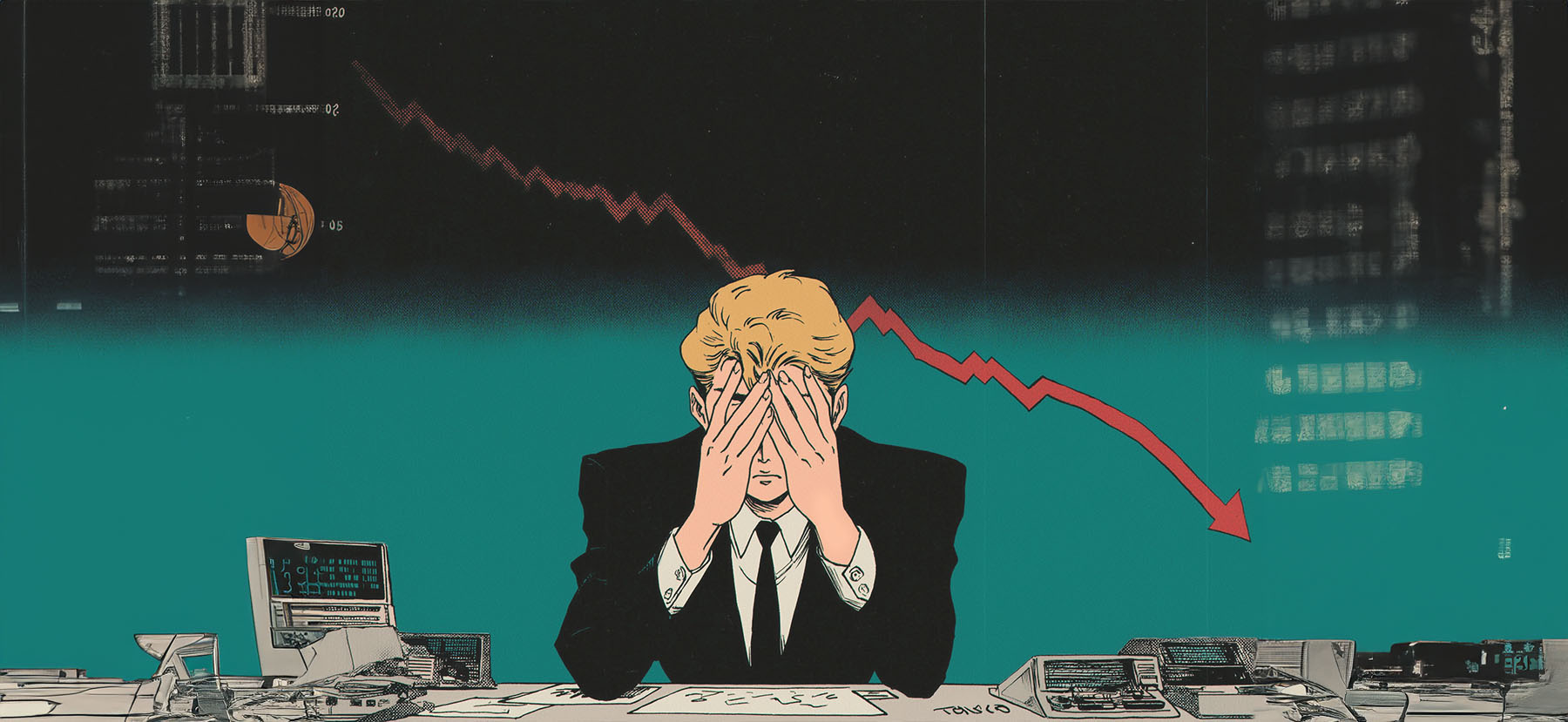

Why investing in your identity when markets get unstable is the right move
The first instinct of most business owners when markets get rough is to cut everything that doesn’t feel essential. Marketing. Branding. Visual identity. The things that “show,” but are hard to justify in front of an accountant.
If you’re watching the economic landscape of 2026 — rising fiscal pressure, repeated tax code adjustments, a climate of uncertainty without a clear systemic collapse — you’ve probably asked yourself: “Is this the right time to invest in brand?”
The short answer is yes. The long answer follows, backed by 100 years of economic data and a few examples you won’t be able to ignore.
What “cutting your brand” actually means in hard times
→ Cutting visibility is a decision with a delayed effect
Your brand doesn’t work like a weekend ad. It works like a layer of memory built over time in the minds of your customers. When you stop investing, you don’t feel the impact immediately.
The Ehrenberg-Bass Institute calculated that a brand that stops communicating loses 16% of sales after one year and 25% after two years. Not all at once. Slowly. And that’s precisely why no one connects the effect to its actual cause.
The problem isn’t that you’ll go bankrupt tomorrow if you go quiet. The problem is that in 12–18 months, when the market stabilizes, you’re no longer in anyone’s mind. The competitors who stayed present have claimed your share of attention.
→ Why market share lost during a downturn is hard to recover
A Harvard Business School study on 4,700 companies found that, among firms that aggressively cut marketing spend during recessions, 80% had not recovered their pre-recession sales levels even three years after the economy bounced back. Only 9% of all companies studied actually grew during difficult periods — and they all shared one common trait: they maintained or increased their investment in visibility and brand identity.
This isn’t about courage. It’s arithmetic. If you go silent and your competitor keeps talking, they gain ground. And the ground gained in a downturn tends to hold well after the downturn ends.
What 100 years of economic crises tell us about brands that invested
👉 Kellogg’s vs. Post, McDonald’s vs. Pizza Hut – decisions that changed industries
In the late 1920s, Post was the undisputed leader of the American cereal market. When the Great Depression hit, Post did what most companies do: it cut its advertising budget. Kellogg’s did the opposite — it doubled its ad spend and launched Rice Krispies.

When Post cut budgets, Kellogg’s invested. The result: a market leader for generations.
By 1933, in the bleakest year of the economic depression, Kellogg’s profits had grown by nearly 30%. Post eventually recovered, but never fully caught up again. Kellogg’s remains an industry leader to this day.

When McDonald’s reduced visibility, Pizza Hut and Taco Bell filled the space.
Another example: during the 1990–91 recession, McDonald’s cut its advertising budget. Pizza Hut and Taco Bell stepped into the void. The result? Pizza Hut grew sales by 61%, Taco Bell by 40%. McDonald’s sales dropped by 28%. For a few years, one decision cost billions.
👉 Data from the 2008 crisis: 3.5x more visibility for brands that kept going
The 2008 financial crisis brought an average 13% decline in global advertising spend. The direct consequence: brands that maintained their level of investment gained 3.5 times more visibility than competitors — without spending more. Simply because everyone else had disappeared.
McKinsey studied brands that continued to invest in innovation and communication through 2009 and found they outperformed the market average by 30% and continued to accelerate for 3–5 years after the recession. BrandZ calculated that brands that invested in brand building through 2008–2009 grew their brand value 20% more than competitors who cut back.
This isn’t theory. It’s a pattern repeated across decades of economic downturns.
What’s specifically happening in the Romanian market in 2026
A year of fiscal pressure, not systemic crisis – but the effects are real
Romania isn’t going through a 2008-style crisis. Analysts describe 2026 as a year of structural adjustment and fiscal transition — sustained pressure, repeated technical modifications, reduced predictability. Government Ordinance 6/2026 and related amendments have created real tensions in the private sector, particularly among SMEs.

Ilie Bolojan announces a package of fiscal measures affecting Romania’s business environment.
What’s happening is that many business owners are entering defensive mode. Cutting back. Waiting. Preserving cash. It’s a human reflex. But on markets where everyone contracts, the one who stays visible claims ground without having to fight for it.
What should a Romanian business do with its branding budget in 2026?
You don’t need to spend more than you can afford. You need to be more strategic with what you have. A well-done brand audit will show you exactly where your image is weak and what you can strengthen with minimal resources. If you’ve been operating without a coherent visual identity, without a clear message, without real differentiation from competitors — now is the best time to build it. Your competitors are retreating. The space is yours, if you show up.
Repositioning doesn’t mean spending a fortune. It means knowing what you are, what you offer, and why your customer should choose you over anyone else. Without that, every price reduction is a step toward a race you can’t win.
Brand is not a luxury. It’s the only thing that protects your margin
Strong brands resist price pressure — weak ones enter a race to the bottom
In a market under economic pressure, customers become more careful with money. And their first move is to look for lower prices. If the only reason they choose you is price, you’re vulnerable to anyone offering cheaper.
A strong brand offers something else: trust, recognition, differentiation. A customer who buys a brand knows what they’re getting. And they’re willing to pay a premium for it – even in uncertain times. Analytic Partners data shows that brand marketing outperforms performance marketing in 80% of cases over the medium and long term. Performance ads don’t build brands. They build transactions.

Design isn’t decoration. It’s an argument (solution included in the Green rebranding carried out by the branding agency BroHouse)
Green Corporation, a client we worked with on a complex rebranding project, understood this. Operating in waste management – a sector often perceived as generic and undifferentiated – the rebrand wasn’t an aesthetic decision. It was a strategic move to claim clear brand positioning in a sector where few competitors communicate anything beyond price. The project resulted in an identity that communicates competence, responsibility, and modernity – exactly what a B2B client looks for when making a long-term partnership decision.
How does your brand protect your price against a cost-sensitive customer?
Through clear brand positioning. When you know exactly what promise you’re making — and communicate it consistently through logo, packaging, messaging, and digital presence – customers no longer evaluate price alone. They evaluate perceived value. And perceived value is built through brand, not discounts.

Moldavia | Packaging design and visual Identity for Eggs. P.S. Solution included in the branding & packaging process carried out by the branding agency BroHouse
Moldavia, a food sector brand we developed from scratch together with the Grup Șerban team, started with a simple brief: logo and packaging for fresh eggs and chicken. The result was a coherent, clean visual identity, instantly recognizable on shelf – in Elena Bufnilă’s own words, Marketing Manager at Grup Șerban. In a category dominated by low prices and minimal differentiation, packaging that communicates quality became a purchase argument that no discount could have built.
This is not the time to disappear. It’s the time to gain ground
→ When the competition goes quiet, your voice gets louder
That’s the simple math of a brand downturn. Advertising spend fell 13% in 2008. If you maintain your level, you automatically become more visible without spending more. If you increase it modestly, the gain is disproportionate to the investment.
Companies in the PIMS database demonstrated a consistent pattern: the rate of market share growth is higher during recessions than during stable periods. Why? Because on a contracting market, the space vacated by those who retreat becomes instantly available to those who stay present.
Harvard Business School calculated that firms that selectively reduced costs – while maintaining marketing and brand investment – were 37% more likely to emerge from the recession in a stronger position than their competitors. Not a guarantee. A structural advantage.
→ What type of brand investment makes sense right now: audit, repositioning, or rebrand?
It depends on where you are. If you have a functional but inconsistent brand, a brand audit will quickly show you what needs fixing and what can stay. If you’ve changed, grown, or your market has shifted, repositioning is likely what you need. If your visual identity no longer reflects who you are today, rebranding isn’t a whim – it’s a strategic necessity.
The worst time to work on your brand isn’t during a crisis. It’s after the crisis has ended, when everyone rushes to recover simultaneously, competing for the same attention, with inflated budgets and high media costs.
How much does it cost to not invest in brand? The answer you don’t want to hear
The cost doesn’t show up in your accounting. It shows up in lost market share, in customers who went to a more visible competitor, in a margin eroded by a price point you could no longer justify. It shows up in the fact that when the market recovered, you were no longer the first name anyone thought of.
Studies across 18 years of economic crises are clear: companies that maintained their investment in visibility and identity didn’t just win long-term. They won immediately, by capturing the market share left open by competitors who pulled back.
Your brand is the only asset you can’t buy quickly once you realize you need it. It’s built over time, through consistency. And the most expensive time to build it is when you no longer have time.
Conclusion
- A crisis isn’t the time to disappear. It’s the time to decide who you want to be when the market comes back.
- The data is clear: brands that invested during difficult periods gained market share, built brand equity, and came out of the crisis stronger than they entered. Those that cut back recovered slowly – or didn’t recover at all.
- In the Romanian market of 2026, the pressure is real. But that’s precisely why every strategic decision carries double weight. Including – or especially – the decision about how you want to be perceived.
Ready to understand where you stand and what needs to be done? Let’s talk. The first step is an honest conversation about your brand and the direction you’re heading.